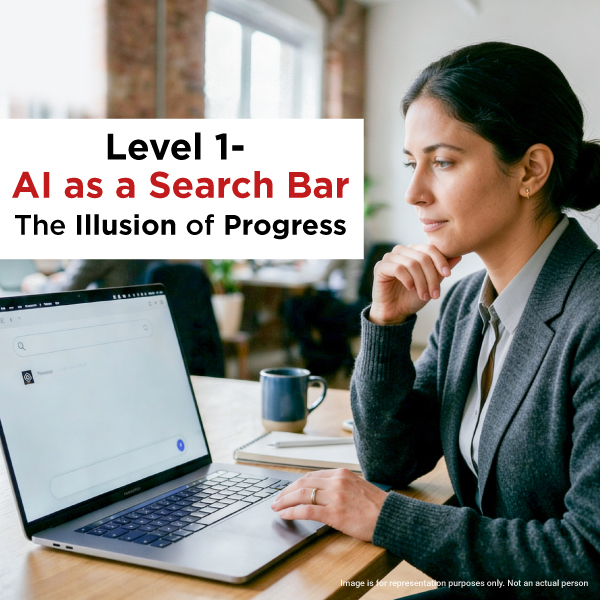
Most Indian businesses are still in the early stages of using AI. For now, artificial intelligence is often just a smarter search tool, not a game-changer for the company. Employees in IT, manufacturing, healthcare, banking, and other fields are experimenting with AI assistants to answer questions, write reports, and prepare presentations faster. These efforts might look like progress, but they usually happen in isolation. There is little connection to business systems or long-term goals, and each use of AI starts and ends without building on past experience or fitting into bigger workflows.
At this early stage, people use AI in their own ways and often only when needed. Some employees try out AI tools every day, while others stay away because they are unsure or not confident. There is no clear system or set of rules for using AI, so it is hard to see what difference it makes. Leaders might know that AI is being used, but they usually do not know how it affects work or decisions. Because of this, AI stays on the sidelines, helping individuals but not driving big changes across the company.
This basic use of AI can make it seem as if real progress is being made. Companies might spend money on subscriptions, workshops, and demos, but without ongoing use, integration, or ways to measure results, AI does not really change how work gets done. If there are no clear ways to track how AI is helping or to connect it to company goals, its use stays scattered and optional. The appearance of activity without real change can keep companies stuck at this stage and prevent them from realizing the full benefits of AI.
VMI India understands that reaching real AI maturity means going beyond random experiments and making AI a key part of the business. They begin by examining how teams actually use AI in their daily work, so companies can see where they really stand. By helping organizations set up clear systems, connect AI to business goals, and remove obstacles, VMI India supports the move from scattered use to regular, effective practices. This approach helps companies move past the early stage and start seeing real, measurable results from AI.