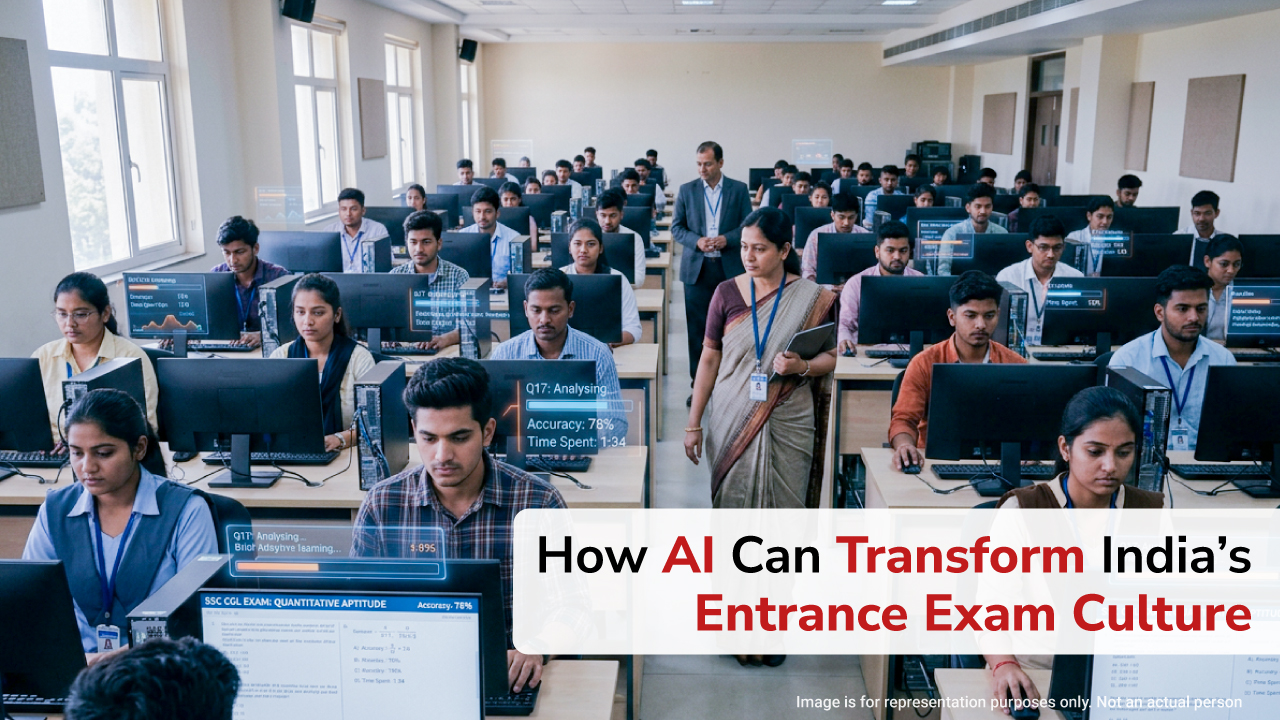
Millions of students across India take entrance exams every year to shape the course of their future. These situations are planned over time by families. Students are crowded into coaching centers, where they take mock exams late at night. whole educational careers have been built on doing well in a few much-needed exams.
The pressure starts early for many students. They are organized by the time they reach higher secondary school, with schedules for preparation, practice papers, and competitive rankings. Energy and focus on exams like engineering, medical, and management entrance tests can pave the way to the big institutions. Meanwhile, the intense rivalry tends to cause stress and worry for both students and families.
The culture of entrance exams in India was aimed at establishing a uniform method for testing millions of applicants across the nation on an equal basis. The large population and low representation of students in top institutions made structured testing a viable way to identify high-performing students. The examinations helped establish a standard for the various education boards and areas.
Nonetheless, the scale and complexity of the Indian education ecosystem have also revealed various drawbacks of this model.
Limitations of the Current Examination System
One high-stakes exam can determine the results of students who have years of preparation. One day's performance can override months or even years of learning. Exam pressure, test anxiety, or other unforeseen factors can greatly influence outcomes.
The other problem is the nature of preparation. Most television entrance tests focus on speed and pattern recognition rather than the ability to conceive concepts at a deeper level. This is likely to cause students to spend time on hundreds of practice questions rather than on their overall learning.
This climate has spawned the development of the huge coaching industry in which performance is often tied to the ability to acquire costly preparation tools. In some cases, students in smaller towns or from lower-income backgrounds might not have access to intensive coaching opportunities.
The potential of reimagining this system has been introduced by artificial intelligence.
How AI Can Reimagine Assessments
The use of AI-based assessment technologies can help change the design, preparation, and scoring of entrance exams. Rather than regarding a single high-pressure examination as the only mode of assessment, institutions would employ more continuous and dynamic forms of assessment.
Consider a learning ecosystem in which learners take smaller assessments regularly. These tests assess conceptual knowledge, analytical ability, and problem-solving skills through various question-and-challenge formats.
Artificial intelligence could compare trends across these tests to create a comprehensive portrait of learners' capacities over time. The system would not assess performance within a single examination window but would take a broader perspective on the nature of learning, adaptation, and the application of knowledge by students.
This would alleviate the high pressure associated with the one-day exams to a great extent.
Continuous & Personalized Learning with AI
The personalization of the preparation can also be done with AI. Students could be given adaptive tests that address their strengths and weaknesses instead of doing thousands of generic questions. If a student is having difficulties with a particular concept in physics or mathematics, the system can identify the weak area and provide targeted exercises to strengthen knowledge.
Additionally, AI-powered learning platforms can track a student’s progress over time and adjust the complexity and type of material presented, ensuring optimal learning pathways for each individual. This means students can learn at their own pace, revisit challenging topics, and receive instant feedback, making the educational experience more interactive and engaging. As a result, continuous and personalized learning with AI not only improves academic performance but also fosters greater confidence and motivation among students.
Such intelligent feedback can help students learn more effectively and clarify their concepts better.
Equity, Accessibility, & Fairness Through AI
The other benefit is related to enhancing equity and accessibility. AI-powered systems can offer standardized tests at different locations. Rural or remote students will be able to receive high-quality evaluation systems without having to move to the big cities to be coached.
Moreover, high-tech analytics can assist institutions in identifying abnormalities, reducing evaluation bias, and implementing more transparent evaluation procedures.
Student readiness is also a good insight that can be obtained through AI-powered assessment systems for universities and policymakers. With the ability to analyze learning behavior and performance at scale, education systems will be better able to understand which skills students have and which curriculum might be improved.
In the long term, this may transform the culture of entrance exams in India into a less competitive, more learning-oriented culture. Learners would not be evaluated based on their ability to perform under stress with an extreme time limit. Instead, analysis, the ability to conceptualize and solve real problems, would take the center stage in evaluation.
This kind of change would not completely abolish exams; however, it would make exams more significant, moderated, and representative of real learning.
VMI India: Shaping the Future of Assessment in India
VMI India enables institutions to create AI-driven assessment systems that surpass conventional testing approaches. The platform assists teachers and administrators in assessing students' abilities more efficiently through smart question generation, adaptive testing systems, and real-time analytics.
Rather than relying on a single time-based test, VMI India promotes continuous, ability-oriented tests that define how students think, learn, and improve over time. Teachers can better understand learning progress, and institutions can conduct assessments of large numbers of students more effectively and transparently.
With India still opening the doors to education and opportunity, the culture of entrance exams will become increasingly critical to change. Using a set of high-tech solutions and carefully designed assessments, such as VMI India, it is possible to develop a system in which speed or memorization is not the main criterion of success but real knowledge and ability.