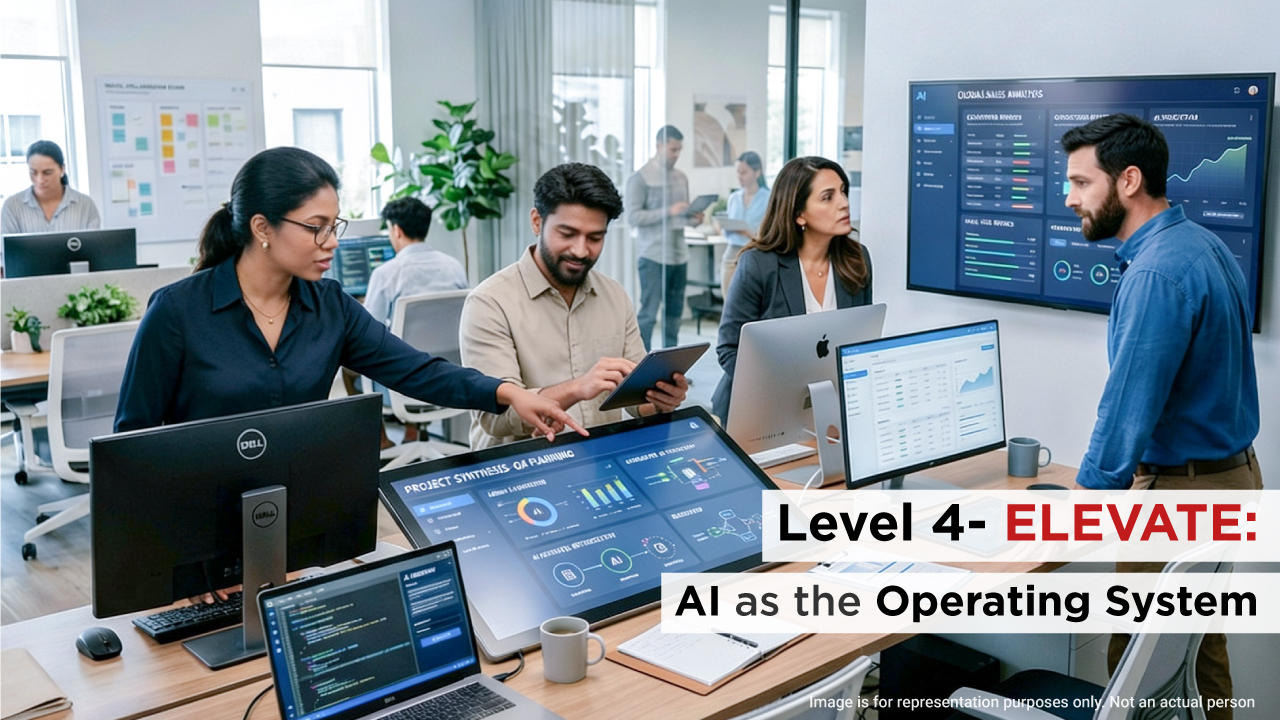
When AI Moves Beyond Individual Productivity & Starts Powering Enterprise Execution
At this stage, the shift is no longer gradual.
AI is not simply being used by employees. It is not limited to assisting individuals with tasks. It is no longer dependent on a few high performers working more intelligently.
AI becomes part of how teams and organizations operate.
This is Level 4.
At this stage, AI evolves into the operating system of work. It becomes embedded into workflows, integrated into delivery systems, and aligned across teams and functions. AI is no longer optional.
It becomes expected.
For the first time, AI is beginning to scale across the enterprise.
What Level 4 Looks Like Inside Indian Enterprises
At Level 4, AI no longer belongs to individuals.
It becomes part of the organizational system.
Teams don't need to use their own methods or workflows. They start to use common playbooks and processes. The use of AI across tasks, roles, approvals, reporting structures, and delivery systems becomes clearly defined.
Whether teams are preparing reports, managing operations, analyzing customer data, creating presentations, or handling strategic planning, AI is integrated into the workflow itself.
Workflows are redesigned to include AI at every stage.
AI-informed insights are being integrated into planning cycles. Structured prompts and systems aid execution. Review mechanisms are powered by AI to enhance consistency, quality, and speed. Teams work together and have a shared understanding of how AI fosters outcomes.
This creates organizational alignment.
Outputs become more predictable. Quality becomes repeatable. Delivery becomes more consistent across functions and locations.
In India’s rapidly growing enterprise ecosystem, especially across sectors such as IT services, GCCs, consulting, banking, manufacturing, healthcare, and digital commerce, this level becomes critical for managing scale.
AI stops being a support layer.
It becomes part of the organization's operating fabric.
The Transition from Talent to Systems
Level 4 represents a fundamental organizational shift.
In earlier stages, value depended heavily on individuals.
At this stage, value is created through systems.
Success is no longer determined by who knows how to use AI effectively. Instead, it depends on how deeply AI is integrated into the organization’s operating model.
This reduces dependence on individual capability.
New hires don't have to learn to use AI on their own. They join structured workflows where the flow of work already includes AI in execution. There is no need to reinvent processes repeatedly. They work cooperatively through common systems.
Leadership gains greater operational clarity.
AI becomes institutionalized.
Why Level 4 Changes Enterprise Performance
Level 4 becomes the turning point for measurable enterprise impact.
For the first time, AI starts influencing how work is delivered at scale across the organization. It no longer exists only in isolated pockets of excellence.
It becomes a shared organizational capability.
This creates three major outcomes:
Consistency: Teams have consistent standards and more consistent results.
Efficiency: The task is done more quickly with less variation in operation.
Scalability: Processes can be replicated to other functions, business units, and geographies.
Organizations begin to see value in their efforts.
AI is no longer considered an experiment.
It becomes infrastructure.
What Organizations Must Build to Reach Level 4
Reaching this level does not happen automatically.
It requires intentional organizational design.
Companies must move beyond awareness programs and isolated training initiatives. The focus shifts toward system-building.
This includes:
Defining how AI fits into each workflow and operational process.
Creating standardized playbooks for different functions, teams, and roles.
Establishing common benchmarks for quality, outputs, and execution.
Aligning leadership expectations and governance structures across the organization.
This is where many organizations struggle.
They attempt to increase AI usage without redesigning how work itself operates. As a result, they continue experiencing individual success alongside organizational inconsistency.
Level 4 requires a different mindset.
Employees are not simply using AI.
The organization itself begins operating through AI-enabled systems.
What Still Needs to Be Strengthened
Even at this stage, several elements still require reinforcement:
Governance: Clear structures are needed to manage AI usage, quality, accountability, and risk.
Measurement: Organizations require systems that track business impact across workflows and teams.
Optimization: Playbooks, workflows, and operational systems must continually improve.
Without these capabilities, organizations may reach Level 4 but struggle to sustain progress.
The system exists.
But it is not yet self-improving.
The Role of VMI India
This is where VMI India enables the transition from structure to scale.
At Level 4, the challenge is no longer adoption.
It is organizational design.
VMI India works with enterprises to embed AI directly into operating models, workflows, and delivery systems. The process begins by understanding how work currently moves across teams, functions, and operational layers. This helps identify where AI can create the greatest strategic impact.
The objective is not to place AI on top of workflows.
The objective is to build AI into them.
The next step is system creation.
VMI India develops structured playbooks that define how AI should support roles, tasks, approvals, decision-making, and deliverables across the organization. These systems are designed around the organization’s specific context, ensuring practical adoption rather than generic implementation.
Workflow integration is then operationalized.
AI becomes embedded into planning cycles, execution systems, reporting frameworks, collaboration structures, and quality reviews. Teams begin operating under common standards, while leadership gains clearer visibility into AI-driven performance.
VMI India also introduces governance and measurement frameworks to ensure AI usage remains monitored, aligned, and continuously optimized.
Organizations stop treating AI as a tool.
They begin treating it as an enterprise capability.
The objective is clear.
Make AI part of the organizational operating system.
What Comes Next
Level 4 proves that AI can scale across the enterprise.
But scaling alone is not the final stage.
The next level begins when systems start functioning with minimal human intervention. Workflows become increasingly automated. AI moves from supporting execution to independently driving parts of it.
That is where operational efficiency becomes exponential.